I read the UBS Global Family Office Report 2026. It surveyed 307 family offices in more than 30 markets, with an average net worth of USD 2.7 billion, between January and March this year.
Of these, 60% plan to change their strategic asset allocation in the next twelve months, the highest share UBS has recorded. Real estate is one of the assets they are cutting. It made up 11% of their portfolios in 2025, and the family offices planning changes expect to hold 8% in 2026. Over a longer period the trend is the same: in 2019, real estate stood at 14%.
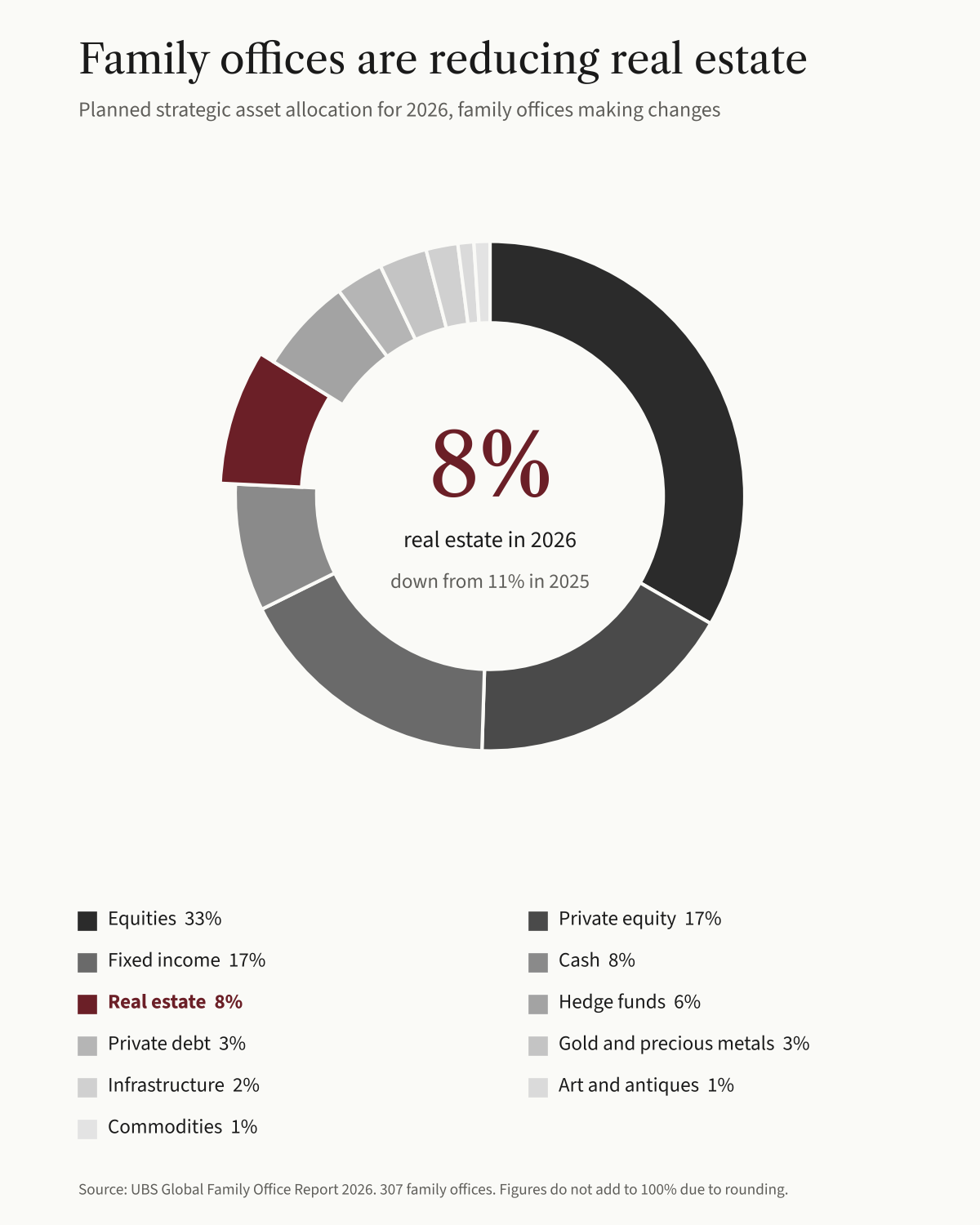
UBS explains the cut partly by property’s recent performance against other assets, and by a near-term outlook that has favoured other investments. Its own chief investment officer for family offices adds that the allocation to real estate remains sizeable. One more figure from the same report stands out to me: for 17% of the families surveyed, real estate is the main operating business. Many of them hold far more property than the portfolio figure shows.
Dubai is in a quieter phase. In September, home prices recorded their first fall in more than five years. Cushman & Wakefield Core described the market in its mid-year update as cooling and more balanced, with buyers and tenants gaining ground.
The registered figures for the third quarter, in my Q3 market note, show the same picture: 32,262 home sales, 37% fewer than a year earlier, and apartments in the same buildings selling for 1.1% less than in the second quarter. The change in price is small. The change in who has the stronger hand in a negotiation is larger.
A balanced portfolio holds assets that behave differently from one another. Property behaves differently from shares and bonds. A well-chosen apartment produces rent every month, it is a physical asset, and when you own it directly you control it: who lives there, what it is let for, when it is sold.
That control matters. A listed real estate fund, a REIT, gives you property income and the freedom to sell on any trading day, but its price moves with the stock market and you have no say in how the buildings are run. Dubai has its own example, Dubai Residential REIT, listed in May 2025 with about 35,700 homes. Direct ownership is slower to sell, and its result depends on choosing the right unit and the right management. The same building can perform well or badly depending on how it is run, so I examine the management as closely as the price.
I look for individual properties, never the market as a whole: units that rent quickly at a strong rent, from owners who want to sell, at a price below recent registered sales in the same building.
I compare every price with registered sales, measured per square foot on the area registered with the Land Department, and I take the median of the last twelve months rather than a single sale. In one building I am working on now, if the owner accepts my offer, the price will be 28% below what similar units in the area have sold for per square foot.
A low price always has a reason. A tenant on a cheap lease, a low floor or a seller who needs to leave Dubai all lower the price, for very different reasons. The work is in finding out which one applies before an offer is made.
Rebalancing means buying good assets when fewer people are competing for them.
Why real estate · What DIFC's growth means for housing · Dubai's supply wave · All articles
Quarterly figures, with the same areas tracked each time, live separately in Market notes.
WhatsApp · dragos.mihalte@savills.me
Dragos Mihalte, Private Real Estate Investment Advisor, Savills Middle East. This is my professional opinion and general commentary, not investment, financial, legal or tax advice.